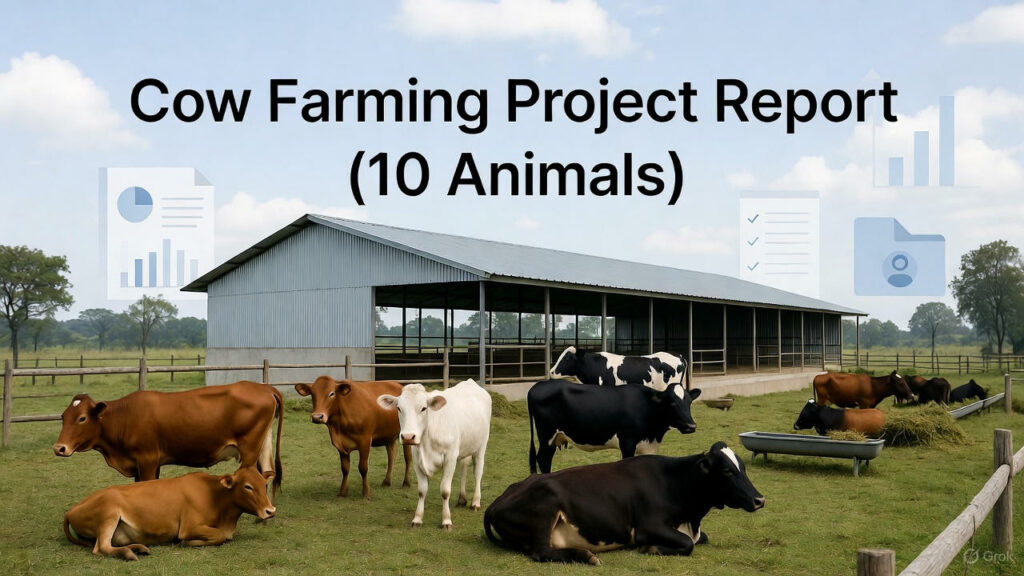


Dairy business is a very exciting business to start, however, with no cow farming project report (10 Animals), it is hard to obtain bank loans or government subsidies. The banks and the subsidy departments are demanding detailed, realistic and financially viable project reports so that your investment is safe and your repayment ability is evident.
This guide will discuss all the requirements of a 10-cow dairy farm i.e. setup, selection of breeds, feeding systems, projection of milk production, investment breakdown, cost of operation and profitability analysis. Besides, learn how Finline offers ready-to-submit, bank-approved project reports that save time and reduce risk.
What Makes a Cow Farming Project Report(10 Animals) Essential for Bank Loans?
A cow farming project report (10 Animals) is not just a mere formality. It is a blueprint of your dairy business that shows your experience, financial analysis and viability of your business.
The banks need this report as it:
- Demonstrates the technical feasibility of your farm set up.
- Financial feasibility of the project, cash flows and break-even points.
- Determines the loan repayment ability.
Concisely, you are likely to have a delayed or rejected loan or subsidy application without a bank-ready project report. A professional project report for bank loan also makes your numbers realistic and market-aligned, increasing credibility.
How Should I Plan the Cow Farm Setup for 10 Animals?
Location and Land Requirement
A 10 animal dairy unit will need about 0.25- 0.5 acres of land which depends on whether you are going to have fodder growing there. Land should have:
- Water sources and markets are easily accessible.
- Permeable ground not to cause waterlogging.
- Close access to veterinary services to provide fast assistance.
Water and Electricity
Water supply is very important in ensuring that the cows have reliable water supply as well as the fodder cultivated. The average amount of water a cow will feed on is about 50 to 80 liters per day. Electricity is also required in:
- Milking machines
- Water pumps
- Lighting and ventilation
What is the Optimal Shed Design for 10 Desi Cows?
- Space per Animal: Allow 40-50 sq.ft. of covered space to each cow and 80-100 sq.ft. of open paddock space. Health and productivity is guaranteed by enough space.
- Floor and Drainage: Anti-skid flooring and well designed slurry drainage system should be used. The integrated farming models require proper waste management in which the cow dung can be re-used as manure.
- Ventilation and Orientation: Design the shed in such a way that there is less heat stress. Proper orientation, natural ventilation and access to sunlight reduces the risk of diseases as well as enhancing milk production.
Check our sample project report for bank loan and make your report fast!
Which Cow Breed is Best for a 10-Animal Integrated Desi Cow Farming Project?
The choice of a breed of livestock is critical in the production of milk and profitability of the farm.
Recommended Desi Breeds:
- Sahiwal: Milk production is high, tough, heat tolerant.
- Gir: Superior A2 milk, disease resistant.
- Rathi: Medium yield in arid areas.
- Red Sindhi: Unsusceptible to local diseases, average milk production.
The areas that should be taken into consideration are adaptability, disease resistance, and demand of A2 milk which fits well in an integrated desi cow farming project report (10 animals).
What Milk Yield Expectations are Realistic for 10 Dairy Cows?
- Mean daily production: 8-12 litres per cow.
- Annual output: Take into consideration dry seasons and weaning.
- Sales price: Depends on the market, but is usually 45-60 per liter.
Realistic projections are powerful and will make your report bank compliant.
How to Establish a Sustainable Fodder System for 10 Cows?
The greatest recurring cost is the fodder costs hence sustainable fodder system is essential.
Fodder Requirement
Each cow consumes:
- Green fodder: 20–25 kg/day
- Dry fodder: 5–7 kg/day
- Concentrates: 2–4 kg/day
Fodder Cultivation
Plant your own Hybrid Napier, Maize or Sorghum in order to save on expenses. This is the 10 animal integrated desi cow farming project report backbone.
Silage and Hay Making
Make sure that there is year-long access to feed by preparing silage and hay when there is excess.
How Much Does It Cost to feed a 10 cow unit every year?
An example of breakdown (approximately):
- Greens fodder farming: 30000/annum.
- Dry fodder purchase: ₹25,000/year
- Concentrates: ₹15,000/year
- Total annual feed cost: ₹70,000
The clear documentation of such costs shows financial viability to the banks. Check our dairy farm project report format for bank loan and understand how it looks!
What is the Total Investment and Fixed Cost Structure for a 10-Cow Dairy Farm?
| Cost Head | Estimated Cost (₹) | Notes |
| Purchase of 10 Cows | 4,50,000 | Includes transportation |
| Cattle Shed Construction | 1,50,000 | As per optimal design |
| Equipment (Milking, Storage) | 50,000 | Milking buckets, storage tanks |
| Total Fixed Capital | 6,50,000 | – |
–
What Operational Costs Must Be Included in the Cow Farming Project Report?
Recurring costs include:
- Fodder/Feed: ₹70,000/year
- Veterinary/Vaccination: 10,000/per year.
- Labor (1 helper): ₹1,20,000/year
- Utilities: ₹15,000/year
- Insurance and Miscellaneous: 5000/per year.
How to Calculate Working Capital Requirements for the First Year?
Working capital will cover the costs until the sales of milk raise enough cash. In the case of a 10-cow unit a minimum of 120,000 150,000 is suggested depending on the feed and labour cost.
How Do You Project the Profitability of a 10-Cow Farming Project?
Revenue Sources
- Milk Sales: Primary income
- Manure, Slurry Sales: Organic farm / market fertilizer.
- Calf Sales: Other income.
Profit Calculation
- Net Profit:Total Revenue- (Operation Costs + Interest/Depreciation).
- Year 1: Mean profit because of the initial investment.
- Year 2-3: The growth is steady because the working capital is stable.
Break-Even Point
The average time taken to reach 2-3 years depending on milk production and the market prices.
Why is Financial Feasibility Crucial for Bank and Subsidy Approvals?
Banks evaluate:
- Debt Service Coverage Ratio (DSCR)
- Internal Rate of Return (IRR)
- Payback Period
Professionally prepared desi cow farming project report (10 animals) will give realistic assumptions that will enhance chances of being given a loan and subsidy.
Your Roadmap to a Bank-Approved Cow Farming Project Report (10 Animals)
A well-prepared project report for a 10 cow farming unit covers:
- Infrastructure: Water, shed, electricity, land.
- Breed choice & milk production: Realistic and market consistent forecasts.
- Fodder and nutritional planning: Cost effective and sustainable.
- Financial planning: Investment, operation expenses, working capital, profitability.
Finline offers a pre-prepared customized cow farming project report (10 animals) that is ready to submit to the banks and subsidy departments. With Finline, you can create a project report in less than 10 minutes in your native language. No need for experts to create the reports, it’s very simple, accurate, and reliable. Every nationalized bank will accept the reports and you will get the financial support very easily. We are offering a very reasonable price to create the reports. Check our pricing details and start it now!
Conclusion
Your dairy business depends on a cow farming project report (10 Animals). Whether it is farm establishment, the type of breed, fodder planning, financial viability and profitability estimates, all details count.
Ready to secure your funding? Get a sample report from Finline and begin your bank- approved cow farming project today.