

Are you searching for a detailed goat farming project report for bank loan?
Goat farming has gone a long way out of being an auxiliary activity of rural families. But now it is an organized form of agribusiness which draws in farmers, first time entrepreneurs and even salaried professionals seeking stable rewards. Nevertheless, goat purchase is not the start of success in this business. It begins with a well-articulated goat farming project report which clarifies the business to the banks, subsidy departments and investors.
The blog is a simple explanation on how a goat farming project report of 50 +3 goats is prepared, how the financial model works and what banks actually want when you apply to take a loan.
Understanding the 50+3 Goat Farming Model
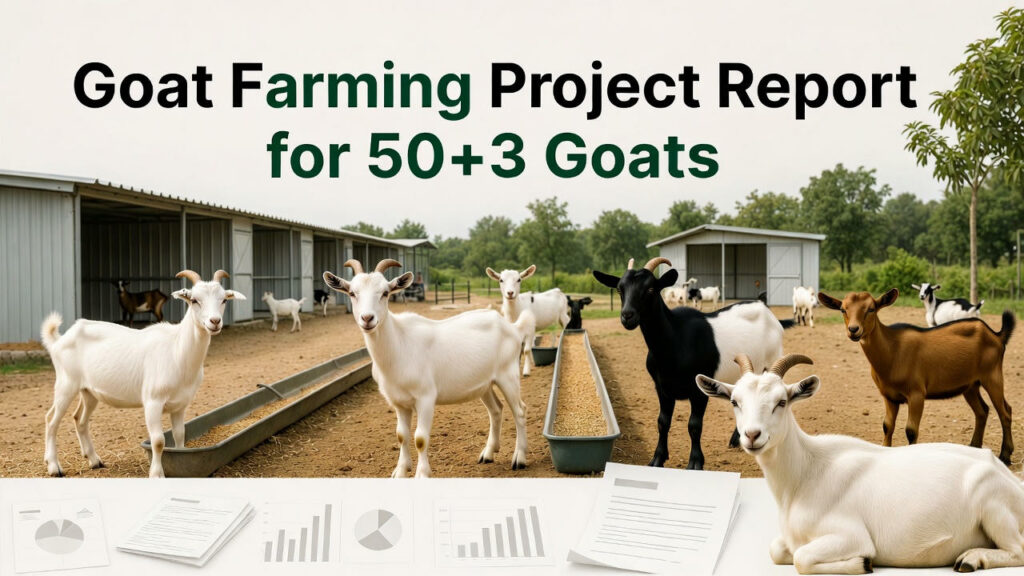
The 50 +3 goat farming model is a commercial enterprise that has 50 female goats (does) and 3 male goats (bucks). The ratio is deemed optimal in the controlled breeding and the stable growth of the herd.
Why is this model popular?
- It is big enough to make a profit.
- It is easy to handle among novices.
- The banks prefer this scale because the income generation can be seen in the 12-18 months.
- It is in line with subsidy based lending plans.
This model has been made to balance the investment, risk as well as income potential thus suitable in commercial planning.
Importance of a Goat Farming Project Report
A goat farm project report for bank loan is not a mere piece of paper. It is a comprehensive business description that provides answers to three important questions to the banks:
- Is the technical feasibility of the project?
- Does the borrower have the ability to handle it?
- Is the income adequate to pay off the loan?
It has been observed that without a structured commercial goat farming project report 50+3 for bank loan applications usually delay or are rejected even though the idea may be good.
Breed Selection for Commercial Goat Farming
Selection of breed has a direct influence on the rate of growth, kidding rate and market price. The reasons as to why given breeds are selected are well explained in a detailed goat farming project report.
Popular Breeds for Commercial Farming in India
- Boer – Fast-growing meat breed, high demand
- Jamunapari – Large body size, good reproduction
- Malabari (Tellicherry) – Hardy and adaptable
- Beetal – Dual-purpose, good kidding rate
- Sirohi – Low maintenance, suitable for dry regions
Breed Selection Criteria
- Local climate adaptability
- Disease resistance
- Weight gain potential
- Demand in the local markets.
Banks would prefer project reports to refer to local breeds available and proven other than exotic only.
Shelter Planning and Infrastructure Requirements
Good housing helps in lowering disease, mortality and stress in goats. In a goat farming project report, shelter planning is one of the technical areas.
Land Requirement
- 0.25 to 0.5 acre is sufficient for a 50+3 unit
- Space for shed, fodder storage, and movement
Goat Shed Design
- Elevated platform system desired.
- Light and adequate air circulation.
- Drainage slatted or concrete flooring.
- Different playgrounds, ailing animals and breeding bucks.
Basic Infrastructure
- Feeding troughs
- Water tanks
- Fencing
- Feed and medicines storage.
The banks seek more realistic and economically reasonable shed planning and not luxury buildings.
Feeding and Nutrition Management Plan
The biggest recurrent cost in the farming of goats is the feed cost. Profitability and bank confidence are enhanced with the help of a realistic feeding plan. Check our sample project report for bank loan now!
Daily Feeding Structure
- Green fodder: Napier, CO-4 grass, local greens
- Dry fodder: Hay, straw
- Concentrates: Oil cakes, grains, mineral mix
Cost-Effective Feeding Practices
- Partially stall fed with control grazing.
- Seasonal fodder planning
- Utilizing domestic by-products.
An excellent goat farm project report describes the manner in which it is possible to manage feeding costs and at the same time not to jeopardize the health of animals.
Health Care and Disease Management
Health management protects your investment. Banks expect a clear vaccination and veterinary care plan.
Common Vaccinations
- PPR
- Enterotoxemia
- Foot and Mouth Disease
- Goat pox
Disease Prevention Measures
- Regular deworming
- Clean drinking water
- Quarantine for new animals
- Periodic vet visits
Including a health contingency provision in the financial model improves loan approval chances.
Breeding and Reproduction Cycle
This part stipulates generation of income. The goat farming will be sluggish and unprofitable without proper reproduction planning.
Breeding Ratio
- 1 buck for 15–20 does
- 3 bucks ensure backup and genetic diversity
Kidding Cycle
- Gestation period: ~150 days
- Average kidding: 1.5 to 2 kids per doe per year
Expected Kid Production
- 50 does × 1.5 kids = 75 kids per year (conservative estimate)
Banks prefer realistic reproduction assumptions, not exaggerated figures.
Manpower and Daily Farm Management
The goat farming does not involve heavy manpower because it requires daily attention.
Labor Requirement
- A single trained worker is capable of handling 50-60 goats.
- There is owner supervision which enhances performance.
Daily Activities
- Feeding and watering
- Cleaning sheds
- Health observation
- Record keeping
There should be justification of labor cost in a commercial goat farming project report 50+3 for bank loan.
Cost Estimation for Goat Farming Project (50+3 Goats)
This is the main part of the financial model.
Fixed Capital Investment
- Goat purchase cost
- Shed construction
- Equipment and fencing
Recurring Expenses
- Feed cost
- Veterinary expenses
- Labor wages
- Electricity and water
- Insurance
Working Capital Requirement
Banks will verify the inclusion of working capital in order to cover the first few months of no revenue.
A professionally groomed goat farming project report does not underestimate which is always a disadvantage in terms of rejection.
Revenue Projections and Income Calculation
There should be diversification in the sources of income.
Primary Income
- Sale of kids at 6–8 months
- Sale of mature goats
Secondary Income
- Manure sales
- Sale of culled animals
- Annual Revenue Outlook
A conservative estimate is used to create credibility. Banks are not fooled with overly optimistic income estimates.
Profitability and Financial Analysis
The most crucial question that is answered in this section is: Is goat farming profitable?
- Key Financial Indicators
- Net annual profit
- Break-even point
- Return on Investment (ROI)
- Loan repayment capacity
The goat farm project report is well organized to demonstrate that profits grow considerably after the second year.
Bank Loan Format for Goat Farming Project Report
Banks have a standard evaluation structure.
Mandatory Components
- Executive summary
- Business profile
- Technical details
- Cost and income statement
- Cash flow and repayment schedule.
Documents Required
- KYC documents
- Evidence of land or lease agreement.
- Quotations
- The eligibility of subsidies.
Commercial goat farming project report 50+3 for bank loan has to be in line with the NABARD and the national bank.
Common Reasons for Loan Rejection
Most of the applications are not successful because of preventable errors:
- Unrealistic profit assumptions.
- Missing working capital
- Improper cost breakup
- Generic, copy-paste reports
- No subsidy alignment
Banks would like personalized and site-oriented project reports.
Why a Professional Goat Farming Project Report Matters
A professional goat farming project report is not just about numbers on paper. It is all about making your business idea presentable in a bankable and remarkable way. Banks seek technical viability, realistic assumptions, and financial sanity. With these elements well organized, competition in terms of loan evaluation is improved and quickened.
This is where Finline comes in with a big role to play. Unlike a general template, Finline is concerned with the creation of project reports that are based on the real situation occurring in a farm, the actual prices, and the feasible income projections, which is exactly what the banks would prefer to receive.
How Finline Supports to Create Goat Farming Project Reports
Finline generates goat farming project reports that meet bank and subsidy requirements, ensuring your application stands on solid ground. All the reports made by Finline are:
- Customized to your location and budget, considering local breed availability, feed costs, and market demand
- Prepared in bank-approved formats, aligned with NABARD and national bank expectations
- Structured to match subsidy norms, wherever applicable
- Designed for faster loan processing, by avoiding unrealistic figures and missing components
Ambiguous formats and applications are not the name of the game; instead, an entrepreneur gets a prepared, practical goat farm project report, which contains an appeal to bankers. Want to know our cost of project reports in detail, check it now!
Conclusion
Goat farming is an economic and expandable agribusiness in case it is put in perspective and with discipline. A goat farming project report for 50+3 goats is not merely a formality, it is a roadmap that will bring your farming concept to bank finance and long term sustainability.
If you want to avoid delays, confusion, and rejection, working with experts like Finline ensures your project starts on the right foundation, with documentation that banks can confidently approve. Create your detailed goat farming project report now!